
If you buy and sell real estate, one of the most important tax questions to ask isn’t about your deductions or your depreciation schedule. It’s simpler than that: are you an investor, or are you a dealer? We’ve been fielding this question often lately, and it’s worth revisiting, because the classification can meaningfully change the tax owed on a sale.
The IRS doesn’t assign this label when you buy a property. Instead, the classification depends on how you actually acquire, hold, use, and sell the property, and the IRS can challenge the treatment you claim after the fact if your activity doesn’t support it. Being classified on the wrong side of that line, particularly after a sale has already closed, can have a significant and largely unavoidable impact on the taxes owed.
What’s the Difference Between a Real Estate Investor and a Dealer?
A real estate investor buys property intending to hold it for the long term, whether that means collecting rental income, waiting for appreciation, or both. When an investor sells property held for investment or rental use, the gain generally qualifies for favorable capital-gain treatment, subject to rules such as depreciation recapture, which is the flip side of accelerated depreciation strategies like cost segregation that many investors use to reduce taxable income while they hold a property.
A real estate dealer, on the other hand, is treated more like a retailer whose “inventory” happens to be land and buildings. Dealers buy and sell frequently, often improving or subdividing properties along the way, with the primary purpose of turning a profit on the sale itself rather than from holding the asset. When a dealer sells, the IRS treats that gain as ordinary income from a trade or business, not a capital gain.
Neither the tax code nor the IRS provides one clean, formal definition of “dealer.” Instead, the classification comes from a body of case law that looks at the full pattern of a taxpayer’s activity, which is exactly why it trips people up.
Why This Classification Matters for Your Tax Bill
The dollars at stake come down to three main areas:
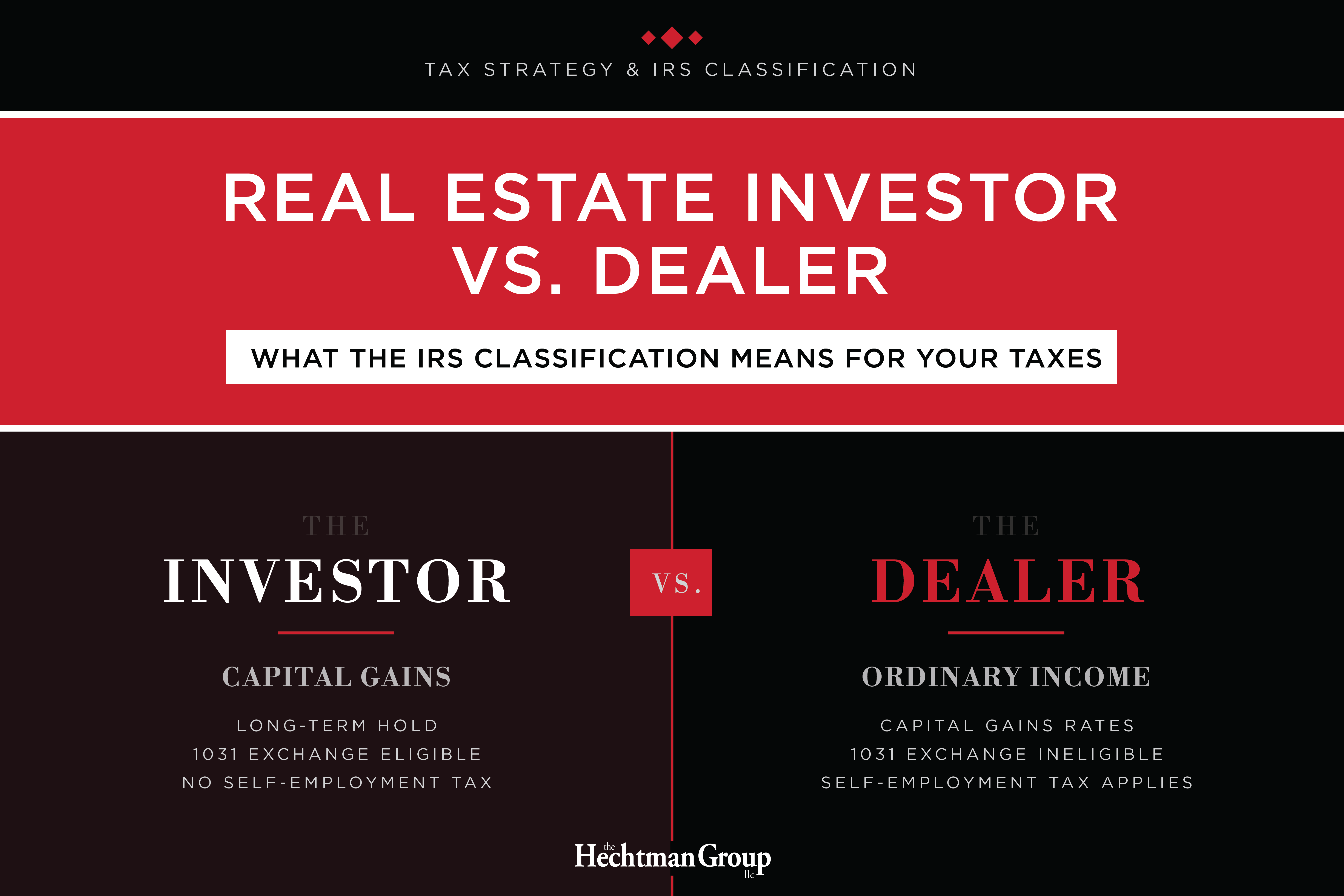
Capital gains vs. ordinary income. Investor gains are eligible for long-term capital gains rates, which are often lower than ordinary income tax rates. Dealer gains are taxed at ordinary rates, which can mean a meaningfully higher federal tax bill on the exact same sale price.
Self-employment tax. Because dealer activity is treated as a trade or business, dealer income can also be subject to self-employment tax, on top of ordinary income tax, when the activity is run as a sole proprietorship or through a partnership. If the activity is instead run through a C-corp or S-corp, it’s taxed differently, through corporate tax and payroll tax on wages rather than self-employment tax, so the entity structure you use matters here too. Investor gains are not subject to self-employment tax.
1031 exchange eligibility. This is often the least understood consequence. A 1031 exchange lets an investor defer capital gains tax by rolling proceeds from one investment property into another “like-kind” property. Dealer property does not qualify for 1031 treatment at all, because property held primarily for sale to customers in the ordinary course of a trade or business is specifically excluded from like-kind exchange treatment. If the IRS successfully argues you were a dealer on a property you tried to exchange, you could lose the deferral entirely, along with any related penalties and interest.
How the IRS and the Courts Decide
Since there’s no bright-line rule, the IRS and the courts weigh a combination of factors, developed over decades of case law (a well-known early example is the 1969 Fifth Circuit decision in United States v. Winthrop). None of these factors is decisive on its own; it’s the overall pattern that matters:
- Purpose at acquisition. Did you buy the property to hold for rental income or appreciation, or to resell for a quick profit?
- Holding period. Longer holding periods may support investor status, while repeated short-term purchases and resales can point toward dealer activity. There’s no minimum holding period that by itself establishes investor status; it’s one factor among several weighed together.
- Frequency and volume of sales. A handful of sales over many years looks very different to the IRS than a steady, ongoing stream of sales.
- Extent of improvements or development. Subdividing land, extensive construction, or substantial rehab work aimed at resale points toward dealer status; modest, ordinary upkeep points toward investor status.
- Marketing and sales effort. Actively advertising, listing multiple properties, or maintaining what amounts to a sales operation looks like a trade or business.
- Time and effort devoted to sales. The more time, effort, and business-like resources (marketing, sales staff, a dedicated office) you put toward selling properties, the more that activity resembles a real estate sales business rather than passive investment.
Can You Be Both an Investor and a Dealer?
Yes, and this is one of the more misunderstood parts of the rule. Dealer versus investor status is determined property by property, not person by person. It’s entirely possible to hold one property as a long-term rental investment while also actively flipping others, and to have the first property taxed as a capital asset while the second is taxed as dealer inventory. The key is that your documentation, your intent, and your actual pattern of activity need to support the classification you’re claiming for each specific property.
How to Protect Your Investor Status
A few practical habits go a long way toward supporting investor treatment when it counts:
- Document your intent at the time you acquire each property, and keep that documentation.
- Hold properties for meaningful periods rather than flipping quickly and often.
- Keep improvements consistent with maintaining an investment rather than preparing inventory for sale.
- Avoid heavy marketing or a sales-office-style operation for properties you intend to hold.
- If you’re actively flipping some properties and holding others, separate entities and separate records may help distinguish the activities, though entity structure alone does not determine tax treatment.
- Talk with your CPA before you sell, not after. Once a sale has closed, your options for managing how it’s classified are far more limited.
This is really a lifecycle question, and the earlier a real estate CPA is involved, from acquisition to exit, the more options you tend to have.
We’ve also written about a related topic worth a look if you’re weighing how real estate activity affects your taxes more broadly: How to Qualify as a Real Estate Professional and Receive the Tax Benefits.
Talk to a Real Estate Tax Advisor Before Your Next Transaction
The Hechtman Group has spent over 50 years helping real estate investors across the Chicago area navigate exactly these kinds of classification questions. If you’re buying, holding, or selling real estate and you’re not sure how the IRS would view your activity, it’s worth a conversation before your next transaction rather than after.
Contact The Hechtman Group and we can walk through your specific situation together.
FAQs
Can I be classified as a dealer for one property and an investor for another?
Yes. The IRS looks at each property individually based on how it was acquired, held, and marketed, so it’s possible to have some properties taxed as capital assets and others taxed as dealer inventory in the same tax year.
If I’ve already established a pattern as a dealer, is it harder to treat a new property as an investment?
Yes. The IRS and the courts look at your overall pattern, and once that pattern points clearly toward dealer activity, the burden is on you to prove a specific property should be treated differently, and courts have found that harder to do than it sounds. In one Tax Court case, a developer with a long dealer history tried to reclassify unsold inventory as investment property, and the court rejected it, largely because he hadn’t kept that property clearly segregated, on paper and in practice, from the start. It’s not impossible, but it takes real, contemporaneous documentation of a different intent and treatment from the moment you acquire the property, not a decision made after the fact.
Does forming an LLC automatically protect my investor status?
No. An LLC or other entity can help organize your activity and support your intent, but it doesn’t change the underlying facts the IRS and courts look at, like holding period, sales volume, and the extent of improvements. Structure matters, but it has to match how you actually operate.
What happens if the IRS reclassifies a sale as dealer activity after I’ve already completed a 1031 exchange?
This is one of the costliest scenarios. If a property is later determined to have been dealer property, the exchange may not qualify for deferral at all, potentially triggering the full gain as ordinary income in the exchange year, along with penalties and interest. This is exactly why it’s worth reviewing your facts with a CPA before attempting an exchange, not after.
How many property sales does it take before I’m considered a dealer?
There’s no fixed number. The IRS and courts look at the whole pattern, including frequency, holding period, improvements, and marketing effort, rather than counting transactions against a threshold. Even a small number of sales can raise the issue depending on the surrounding facts, while no specific number of transactions automatically makes someone a dealer.
Sources referenced: IRS Publication 544, Sales and Other Dispositions of Assets; United States v. Winthrop, 417 F.2d 905 (5th Cir. 1969); Boree v. Commissioner, No. 14-15149 (11th Cir. 2016).