
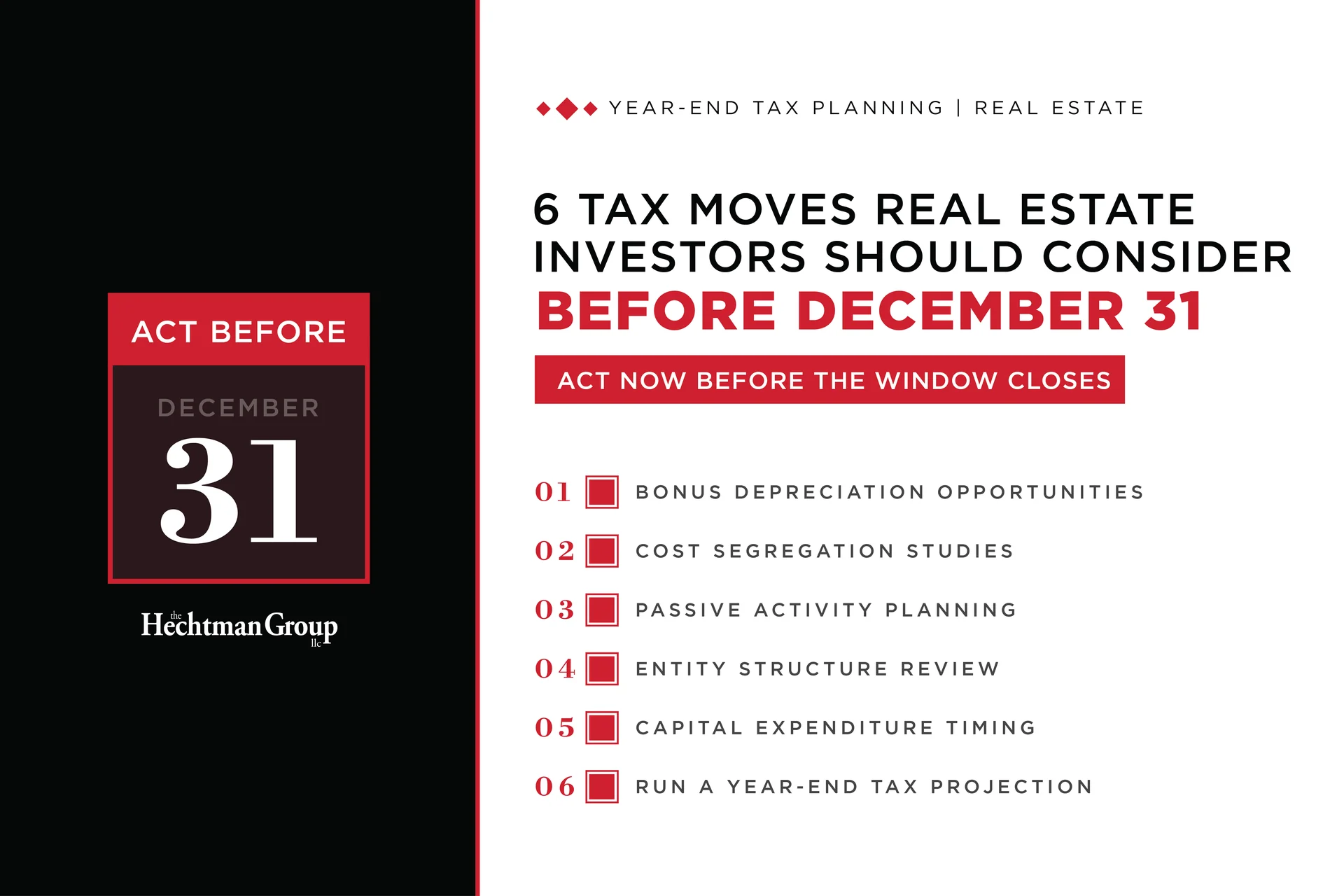
For real estate investors, the planning window on several of the most consequential tax strategies available closes December 31, not April 15. Here are six tax moves to consider before the end of the year.
1. Bonus Depreciation Opportunities
Under current law, 100% bonus depreciation is available for qualifying property placed in service after January 19, 2025, and before January 1, 2031. “Placed in service” is the operative term that indicates an asset is in a condition and state of readiness for its intended use, not simply when construction begins or payment is made. For projects currently underway, that determination needs to happen before December 31. Confirming service dates now, well before filing, protects the deduction for this year.
2. Cost Segregation Studies
A cost segregation study is most valuable when completed before year-end, particularly for properties acquired or substantially improved this year and eligible for 100% bonus depreciation. Components reclassified into 5-, 7-, or 15-year recovery periods may be fully expensed in the year they are identified, rather than recovered over 27.5 or 39 years. A lookback study can also recapture accelerated deductions on prior-year acquisitions through a change in accounting method, without amending prior returns. Cost segregation studies are fully deductible.
3. Passive Activity Planning
Rental losses are passive by default under IRC §469 and can only offset passive income. Before December 31, review whether suspended passive losses can be freed up through passive income generated this year or through a full disposition of an activity. Investors approaching the 750-hour threshold for real estate professional status should track remaining time carefully. Qualifying before December 31 means rental losses for the full tax year can be treated as nonpassive, potentially making them deductible against ordinary income.
4. Entity Structure Review
Year-end is a practical time to confirm whether your current entity structure still fits the portfolio. Investors who added properties, partners, or family members during the year should verify that the existing structure still makes sense from a liability and tax standpoint. S-corp elections for the upcoming tax year must be filed by mid-March, so a December decision preserves that option. Proactive coordination between a tax advisor and legal counsel ensures any changes are structured correctly across both dimensions from the start.
5. Capital Expenditure Timing
CapEx placed in service before December 31 can generate current-year deductions through bonus depreciation, Section 179, or standard depreciation schedules, depending on asset type and eligibility. Investors who expect higher taxable income next year may benefit from accelerating planned improvements into this year; those who have already maximized this year’s deduction position may prefer to defer. The right call depends on how this year’s projected income compares to next year’s. A year-end tax projection provides that answer.
6. Run a Year-End Tax Projection
The five strategies above do not operate independently. The value of any deduction depends on projected taxable income, passive loss limits, and estimated tax position across the portfolio. A year-end projection runs all three together and identifies which planning options remain available before December 31. It also informs Q4 estimated payment decisions, where underpaying and overpaying both carry real costs.
Review Your Year-End Tax Position With The Hechtman Group
The Hechtman Group has spent decades working with real estate investors across the Chicago area, helping clients identify and act on year-end planning opportunities before deadlines close them off.
At The Hechtman Group, we partner with real estate investors to build proactive, personalized strategies that align with both current law and long-term goals. If you’re ready to take a smarter approach to 2026, schedule a consultation with us to learn more about our real estate services.
FAQs
Can I claim bonus depreciation on a property that’s still under construction at year-end?
Generally, no. Bonus depreciation requires the asset to be placed in service by December 31, meaning it must be complete and ready for its intended use, not simply paid for or partially built. A project still under active construction at year-end does not meet that standard. Individual components that are complete and functional before December 31 may qualify independently. A cost segregation study on a partially complete project can identify those components and capture any available deductions for the current year.
How do I know whether a cost segregation study is worth commissioning on my property?
The analysis comes down to two factors: the property’s cost basis and your current tax position. Studies tend to generate the most value on properties with an acquisition or improvement cost above roughly $500,000, where the volume of reclassifiable components is large enough to justify the study fee. Investors who are already carrying more passive losses than they can currently absorb may see limited near-term benefit, even on a well-suited property. A real estate CPA can project deductions before the study is commissioned, giving you a clearer picture of whether the timing makes sense for your situation.
What counts as passive income for purposes of freeing up suspended passive losses?
Passive income under IRC §469 generally includes income from rental activities and from trades or businesses in which the taxpayer does not materially participate. For real estate investors, common sources include net rental income from properties held as a passive owner and distributions from passive partnership interests. Wages, self-employment income, interest, dividends, and capital gains do not qualify as passive income and cannot offset suspended passive losses. Suspended losses can also be fully released through a complete, taxable disposition of the activity that generated them, which is why year-end property sales sometimes serve a dual purpose in tax planning.